
Kerman Tourism Park
Kerman, Iran | Landscape Architecture, Heritage Conservation & Urban Regeneration
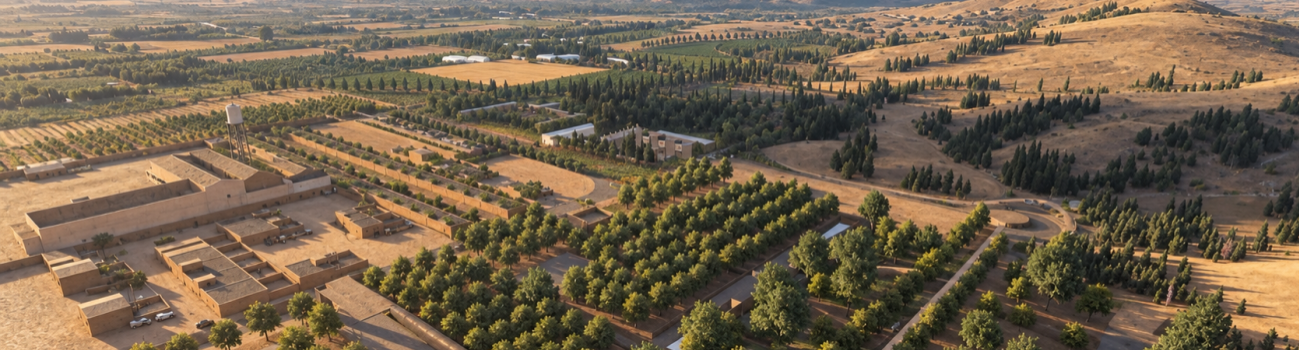
Kerman Tourism Park is the outcome of five years of interdisciplinary research, planning, and design, exploring the relationship between cultural heritage, ecological systems, and contemporary urban life. Situated within a historically significant landscape in Kerman, Iran, the project proposes an alternative to conventional urban parks: a productive, culturally rooted landscape that reconnects the city’s historical monuments, agricultural traditions, natural environments, and surrounding communities.
The project approaches the site not as an isolated recreational destination, but as part of a larger historical and ecological territory. Its design strategy is structured around the preservation of the site’s cultural and natural identity, the regeneration of its agricultural landscape, and the creation of meaningful connections between heritage sites and public spaces.
A central intervention is the establishment of a network of visual and pedestrian connections between significant historical landmarks, including Ardeshir Castle, Dokhtar Castle, the Jabalieh Dome, and the surrounding mountains. Rather than treating these monuments as isolated objects, the proposal seeks to recover their spatial and cultural relationships within a continuous landscape.
Agriculture forms the project’s primary landscape infrastructure. Existing agricultural fields and historic gardens are incorporated into the park’s spatial organization, preserving the region’s productive heritage while introducing opportunities for education, public participation, and seasonal activities. This approach challenges the conventional model of resource-consuming urban greenery by envisioning the park as a productive landscape.
Water management is another fundamental design strategy. The project investigates the historical systems of qanats, irrigation channels, and traditional gardens, proposing their rehabilitation as part of an integrated ecological network. Water-efficient landscaping, the restoration of degraded landforms, the protection of existing habitats, and the use of locally appropriate materials aim to establish an environmentally responsive approach suited to Kerman’s arid climate.
Architectural interventions are conceived as complementary elements within the landscape rather than dominant objects. The design framework emphasizes the continuity of the terrain, the preservation of historical views, and the careful integration of new cultural, recreational, and tourism facilities with the site’s archaeological and environmental sensitivities.
Beyond its physical transformation, Kerman Tourism Park addresses the social and economic regeneration of the surrounding urban fabric. Through accessible public spaces, cultural activities, opportunities for local employment, and community participation, the project seeks to improve urban safety, strengthen collective identity, and establish a sustainable relationship between tourism and everyday life.
Developed through five years of research and design, the project brings together heritage studies, landscape ecology, urban planning, social research, and architectural design into a comprehensive vision for Kerman’s future.
Ultimately, Kerman Tourism Park proposes a living cultural landscape in which preservation is not understood as the freezing of history, but as the continuation of historical, ecological, and social processes through contemporary life.